Dragonfly for AI frameworks: search, memory, and a Redis-compatible path to production
Dragonfly is a Redis-compatible backend for AI search, memory, and runtime in LangChain, LlamaIndex, Agno, Semantic Kernel, and more.

October 30, 2026
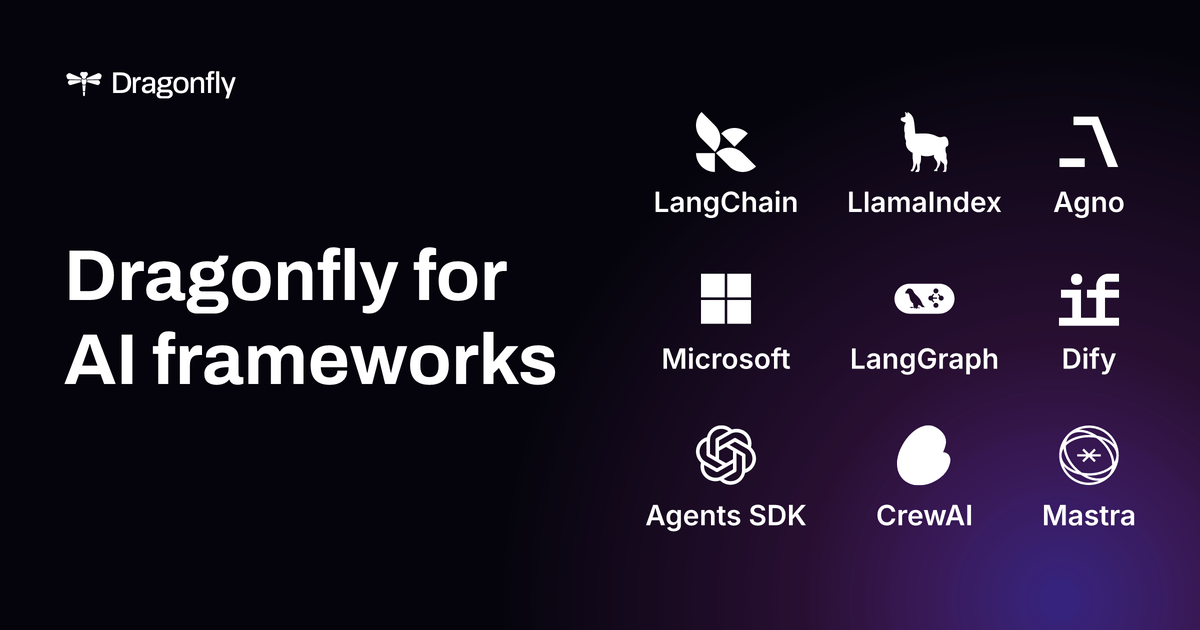
AI products are scaling faster than products ever have before. And the infrastructure underneath them needs to support that rapid growth. Traffic, agent adoption, and context size keep climbing, and many of these data access patterns require high-throughput or multi-key search.
Modern AI apps require much more than the model alone, they require: embeddings, retrieval, semantic cache, conversation history, checkpoints, queues, locks, Pub/Sub, Streams, and a handful of other things show up next to it. These are components that look tidy in an architecture diagram but each carry real operational weight in production.
Many AI frameworks already depend on Redis. Dragonfly is a fully compatible, drop-in replacement that lets teams keep their existing Redis integrations while improving performance and scalability - without changing product logic.
The quality of RAG, agent memory, and semantic caching largely depends on context-retrieval latency. To deliver production AI, you need a high-performance search surface. By leveraging Dragonfly FT.CREATE, FT.SEARCH, native KNN, and JSON-path hybrid retrieval, you ensure the agents receive the most relevant context in milliseconds, directly elevating the final user experience.

Redis-compatible integrations converge on Dragonfly as the shared AI memory and search backend.
Why AI apps need a search backend, not just a cache
In classic web systems, Redis often started life as a cache. In AI products, the backend's role is wider: semantic cache cuts repeat LLM calls for similar queries, vector search finds documents by embedding similarity, full-text search catches exact terms, metadata filters keep retrieval inside a tenant, workspace, user scope, or conversation thread, and checkpoints hold the state of an agent workflow.
These jobs converge naturally on a Redis-compatible search layer. AI frameworks already use Redis clients, RedisVL, RediSearch-style commands, JSON storage, HASH storage, and KNN queries. Dragonfly speaks the same language and adds a production-friendly in-memory backend built for heavy load.
For teams building RAG, agents, or AI platforms, this means one backend for cache, memory, vector search, and coordination: fewer services in the deployment and less glue code.
Where Dragonfly fits into popular AI frameworks
The shortest adoption path shows up wherever a framework already has a Redis or Redis-compatible integration. In those cases, Dragonfly becomes a backend replacement: the endpoint changes, the application flow stays familiar.
LlamaIndex: documents, chat history, and a vector store
LlamaIndex integrates via Redis-compatible APIs, with packages for a KV store, document store, index store, chat store, and vector store. It's almost the ideal AI set: documents, indexes, conversation history, and vector retrieval all live in a unified API platform instead of scattering across multiple fragmented services that add huge cognitive load to the engineering teams.
Dragonfly fits this scenario entirely and can serve as a drop-in replacement for all these use-cases - including the vector store with KNN search, metadata filters, count, and delete.
from llama_index.vector_stores.redis import RedisVectorStore

vector_store = RedisVectorStore(
    schema=my_schema,
    redis_url="redis://dragonfly:6379",
    overwrite=True,
)LangChain: semantic cache and vector retrieval
LangChain has a broad Redis ecosystem that covers the usual AI needs: vector store, semantic cache, chat history, JSON-backed cache, and metadata search. If an AI team runs LangChain with Redis-backed retrieval, Dragonfly is a direct backend path for that layer.
In RAG, LangChain reaches the vector store through Redis-compatible search APIs. In semantic-cache scenarios, the backend handles finding similar queries quickly. In chat history, it holds the conversation's context. Dragonfly brings these jobs together in one Redis-compatible runtime, so the team runs them on a single backend instead of several separate services.
Agno: agent memory and hybrid search
Agno shows just how deep a Redis surface can run inside an agent framework. There's a session database, a cancellation manager, and a vector database with vector, keyword, and hybrid search. For agents this matters: memory has to return the right pieces of context at the right time, not just store them.
Dragonfly sits well in this model. Agent sessions, run coordination, vector retrieval, and hybrid search all go through one Redis-compatible backend. That trims the number of moving parts and makes agent memory more predictable in production. And Dragonfly's multi-threaded architecture leaves headroom for load as the number of agents grows.
Hybrid search is a strong point on its own. Pure vector similarity is good at finding the semantically close. Keyword relevance is good at catching exact terms. Together they return on-target context more often than either method alone. Agno runs this through redisvl's native FT.HYBRID, which Dragonfly executes directly, so hybrid search works wherever a framework expects a Redis-style search backend.
Semantic Kernel: a Redis vector store for enterprise AI
Semantic Kernel adds an important enterprise dimension. A lot of AI features get built not only in Python notebooks but in .NET/C# environments, where the Redis connector, JSON commands, vector search, and client libraries all have to work as part of a production platform.
Dragonfly supports the Redis-compatible search and JSON scenarios behind that vector-store layer. For teams building AI products with Semantic Kernel, it means a familiar route: bring Dragonfly in as a Redis-compatible backend and use it for vector search without rethinking the application's architecture. The .NET path uses the standard NRedisStack client (FT.CREATE, FT.SEARCH with KNN, JSON.SET/GET), which Dragonfly serves directly.
This extends Dragonfly's AI search support beyond the Python ecosystem into stacks where enterprise teams already have their clients, deployment practices, and stability requirements.
LangGraph: durable state for agents, right next to search
LangGraph makes agent workflows more manageable: state, checkpoints, cache, and resume behavior become part of the graph. In production, that's not a minor detail. When a workflow can reliably resume, an agentic architecture moves from a diagram to a real product, because a checkpoint decides whether the agent continues from where it stopped or loses that state on a crash.
Dragonfly works as a Redis-compatible backend for checkpoint persistence and cache in LangGraph, storing checkpoints as JSON with a sorted-set key registry. And once semantic middleware, a vector store, or a tool cache show up alongside it, Dragonfly's search capabilities become a natural extension of the same runtime layer.
Dify: an AI platform with a Redis-compatible runtime layer
Dify uses a Redis-compatible backend for its broker, cache, rate limits, locks, Pub/Sub, Streams, and coordination. This is a platform story: AI workflows need more than retrieval - they need dependable runtime infrastructure.
Dragonfly takes that role as a fast Redis-compatible backend and, at the same time, opens a path toward search consolidation. For self-hosted AI platforms, that's especially valuable: fewer separate services, simpler deployment, one clear backend for runtime primitives and search.
One practical note for Dify: a full drop-in is the image swap plus a single launch flag (--default_lua_flags=allow-undeclared-keys) for its server-side Lua scripts, with no changes to application code.
Dragonfly AI framework workload map
Framework | Vector | Hybrid | Semantic | Memory | State | Runtime |
|---|---|---|---|---|---|---|
LlamaIndex | ● |
|
| ■ |
|
|
LangChain | ● |
| ● | ■ |
|
|
Agno | ● | ● |
| ■ |
| ▲ |
Semantic Kernel | ● |
|
|
|
|
|
LangGraph | ○ | ○ | ○ |
| ● | ▲ |
Dify |
|
|
|
|
| ▲ |
OpenAI Agents SDK |
|
|
| ■ |
|
|
CrewAI |
|
|
|
|
| ▲ |
Mastra |
|
|
| ■ |
| ▲ |
AutoGen | ● |
|
| ■ |
|
|
Microsoft Agent Framework | ○ | ○ |
| ■ |
|
|
● Core search path · ○ Adjacent path · ■ Memory/storage · ▲ Runtime. This is a fit map, not a benchmark chart.
A product-facing map of where Dragonfly fits across AI search, memory and runtime paths.
Not only search: runtime primitives matter too
Search is the focus here, but production AI doesn't live on FT.SEARCH alone. There's always session memory, TTL cache, queues, Pub/Sub, locks, counters, and the small utility keys that rarely appear in a keynote but often keep the product running.
OpenAI Agents SDK, CrewAI, Mastra, AutoGen, and Microsoft Agent Framework show a wider class of Redis-compatible AI workloads: sessions, cache, coordination, streams, history providers, and memory stores. Dragonfly covers that layer right next to search, so an AI team gets not just a vector backend but a runtime foundation for agents and workflows. Mastra, for example, runs its event bus on streams (XADD, XREADGROUP, XAUTOCLAIM).
That matters for adoption. A team can start with cache or session storage, add semantic cache later, then move on to vector or hybrid search. Dragonfly doesn't force a big leap: each step uses a Redis-compatible API.
How to start using Dragonfly with an AI framework
The shortest path is to find the place where your framework accepts a Redis URL or a Redis client, and point it at a Dragonfly endpoint.
REDIS_URL=redis://dragonfly:6379In Python, that's often redis_url, from_url(...), from_conn_string(...), or a Redis client you pass in. In TypeScript, .NET, or Java, it's a connection string for the usual Redis-compatible client.
For a search-heavy workload, you can start with one concrete path:
- LlamaIndex Redis vector store, or chat/document storage.
- LangChain semantic cache or RedisVectorStore.
- Agno agent memory and hybrid search.
- Semantic Kernel Redis vector store.
- LangGraph checkpoints and semantic middleware.
- Dify Redis-compatible runtime backend.
This keeps adoption visible: one framework path, one Dragonfly endpoint, one production-like workflow.
Dragonfly alongside Redis and Valkey
Many AI frameworks already expose Redis or Valkey-compatible integration points. Dragonfly belongs squarely in that category: it speaks the familiar protocol, supports the commands you need, and gives AI teams a strong backend for memory, cache, and search.
The practical question is simple: if your AI stack already has a Redis URL, a Redis client, or a Valkey-style deployment path, Dragonfly is a compatible, fast option for that spot in the architecture.
For search workloads, that compatibility is especially valuable. Vector search in frameworks comes down to specific query shapes, metadata filters, JSON paths, KNN aliases, and client expectations, and small differences here decide whether an integration works. A typical redisvl KNN query with SORTBY on an alias runs out of the box on Dragonfly, while Valkey-search rejects that same query. In practice, the vector store fails on Valkey across LlamaIndex, LangChain, Agno, and Semantic Kernel but works on Dragonfly. Dragonfly is the best technology that permits all its search features to run in commercial workloads, and Valkey still does not support most of these frameworks at the time of writing.

Start with the integration point your framework already exposes, then consolidate memory, search and runtime primitives on Dragonfly.
Conclusion
AI frameworks keep getting more practical, and practical systems always need infrastructure: memory, cache, search, queues, locks, and checkpoints. Dragonfly pairs a Redis-compatible adoption path with the search and vector capabilities modern AI apps actually need.
For LlamaIndex, LangChain, Agno, Semantic Kernel, LangGraph, and Dify, that means a clear Redis-compatible route: drop Dragonfly in where the framework already expects a Redis-style backend, and use it for memory, semantic cache, retrieval, or runtime coordination.
Dragonfly makes the AI stack smaller and steadier: fewer services, less glue code, and more search that returns the right context exactly when the model needs it.
– Compatibility in this article was verified against Redis 8.6 and Valkey 9.1 with valkey-search 1.2.